
Distressed vs Below Market.
Why seller desperation isn’t a bargain.
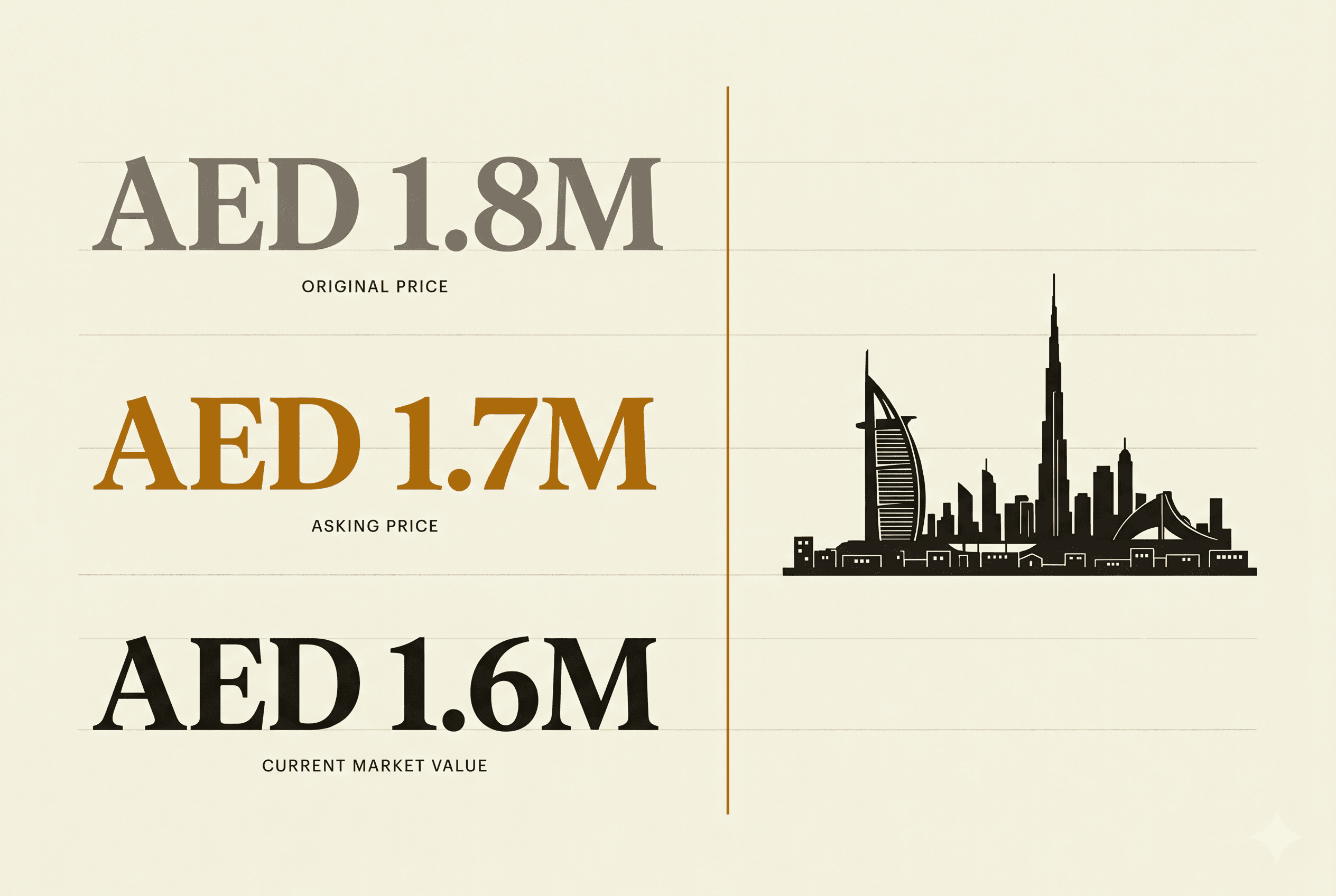
In late 2025, a sea-facing studio in Dubai Maritime City came across our desk. The owner had bought it during the pandemic at AED 1.8M. Comparable studios in the same building now trade at AED 1.5M to AED 1.6M.
The owner was asking AED 1.7M. The listing was tagged distressed sale, and it was true. Real loss for the seller. Balloon payment due. They wanted out within sixty days.
Five investors asked us about that listing in three weeks. Two were ready to sign.
If they had bought at AED 1.7M, they would have walked into that flat with AED 100K of unrealised loss the same afternoon. The seller’s distress was real. Their loss would have been real too. Both things can be true at the same time, and in Dubai today, both things often are.
We see this almost weekly. We have a name for it: the Distress Trap.
A seller is distressed when their asking price is below what they originally paid. That is a fact about the seller. It tells you they are motivated. Nothing else.
A deal is below market when the asking price is below what comparable units actually trade for today. That is a fact about the asset. It tells you whether the buying price is a discount.
These are independent. A seller can be deeply distressed and still asking far above today’s market. A non-distressed seller can be offering a real discount because they want to close in two weeks.
Distress is psychology. Below market is math.
The trap is treating them as the same thing. In 2025 Dubai, they are usually not.
See for yourself
The simulator below is loaded with that Maritime City studio. Drag any slider, or click the colored buttons to drop into other Dubai scenarios.
Click . A family in Damac Lagoons going through a divorce. Bought at AED 2.0M two years ago. Comps now sit at AED 2.4M. They listed at AED 1.9M for a fast close. Small loss for the seller. AED 500K of instant equity for the buyer. Distress and below market.
Click . A friend of ours in JVC, relocating to Singapore. Bought at AED 1.0M, market now at AED 1.5M, listed at AED 1.3M for speed. He profits AED 300K. The buyer gets AED 200K of equity. The seller’s profit is irrelevant to your math.
Click back to . Same Maritime City studio. Same loss for the seller. Same loss for you.
The framework is precise. Move the negotiation slider on the Trap from 0 to 13%. Watch the verdict turn green at the moment the asking price drops below CMV. That’s not a vibe shift. That’s the boundary of your bid.
When you’ll see this in real life
The Distress Trap rarely arrives wearing a sign. It comes wrapped in three smaller traps, each costing you the same money in different costume.
“It's been listed for six months, the seller's getting desperate.”
Time on market tells you the seller will negotiate. It does not tell you the unit is worth less. A six-month-old listing at trap pricing is still a trap. Use the time pressure as leverage, not as proof you've already arrived.
“It comes with a tenant on a long lease at AED 100K a year.”
Sounds like a feature. It's actually a constraint on the valuation. Tenanted units are valued through yield, not comps. Yield-based CMV is roughly Annual Net Rent ÷ Target Yield. At a 7% target, AED 100K of rent is worth AED 1.43M, not AED 1.7M. Calculate both CMVs. Use the lower one.
“Hope, dressed up as strategy.”
The gap between AED 1.7M asking and AED 1.5M CMV is AED 200K. Your bid is CMV minus 5–10%, which is AED 1.35M to AED 1.42M. If the seller can’t get there, you walk. There is no middle ground that “saves” the deal. The middle ground is a smaller version of the trap.
The three traps share one mechanism: each substitutes a story for the math. Time pressure tells the story of urgency. Rental income tells the story of productive returns. Negotiation tells the story of solvable problems. Stories feel like understanding. None of them changes whether you're paying above market today.
(Asking < OP)
(Asking ≥ OP)
(Asking < CMV)
(Asking ≥ CMV)
What to do this week
The next time someone forwards you a “distressed sale” on WhatsApp, do not reply immediately.
Pull three numbers. Original price. Current market value, against three recent comps in the same building or community. Asking price. Identify the quadrant.
If it’s a Distress Trap, walk. The seller’s loss is not your gain.
If it’s a Sweet Spot or Smart Play, verify the CMV and move within forty-eight hours.
Ninety seconds per deal once you've done it ten times.
We see roughly a thousand active signals a week across eighty-five Dubai communities. We built BelowMarket Intel because we kept losing time to the same misreadings. Once the framework is wired into the data layer, the trap stops being an emotional decision and becomes a verdict. Referral required.
Have a deal you'd like us to apply this framework to? Reply to hello@belowmarketintel.com — we respond personally.